
Thursday, 22Oct 2026
Software Rollout Training: How to Design eLearning That Gets Employees Productive on a New System from Day One
A new core banking platform, an ERP…

Monday, 20Apr 2026
Here is a scenario every L&D leader recognises immediately. You launch the annual compliance training. Completion rates look decent on paper. But three months later, the same policy violations are happening. The same mistakes are being made. And your leadership is asking why training did not prevent them.
The problem was never the compliance requirement. The problem was how the training was designed.
Compliance training eLearning has a reputation—and not a good one. Employees often see it as the most dreaded item in their learning queue. Why? Because it is long, text-heavy, and full of click-through screens that feel more like legal disclaimers than real learning.
But here’s the irony.
Compliance training covers some of the most critical topics an organisation delivers—workplace safety, data privacy, anti-harassment, financial regulations, and industry-specific laws.
When compliance training fails, the impact goes far beyond low completion rates. It leads to regulatory penalties, legal risks, reputational damage, and a workforce that treats policy like paperwork instead of principle.
So the real question is not how to force completion.
The real question is this:
How do you design compliance eLearning that people engage with, understand, and actually apply?
This blog gives you a clear, practical answer.
Before exploring solutions, it is worth understanding why so much compliance training underdelivers — even when organisations invest significant time and budget in it.
The most common reason is that compliance training is designed around legal coverage, not learner understanding. Content is written by legal or compliance teams whose primary goal is demonstrating that the organisation fulfilled its disclosure obligations. The result is training that reads like a policy document, presented as slides, and assessed with true-or-false questions that anyone can pass by clicking randomly.
Additionally, compliance training is frequently treated as a one-time annual event rather than an ongoing learning process. Learners absorb content once a year, complete a checkbox assessment, and move on — with very little retention or behavioural change to show for it.
Furthermore, most compliance eLearning ignores context. Telling a warehouse supervisor and a finance analyst the same generic information about data privacy — with the same examples, the same scenarios, and the same assessment — misses the reality of how different their compliance risks actually are.
These are fixable problems. And fixing them is exactly what effective compliance training eLearning is designed to do.
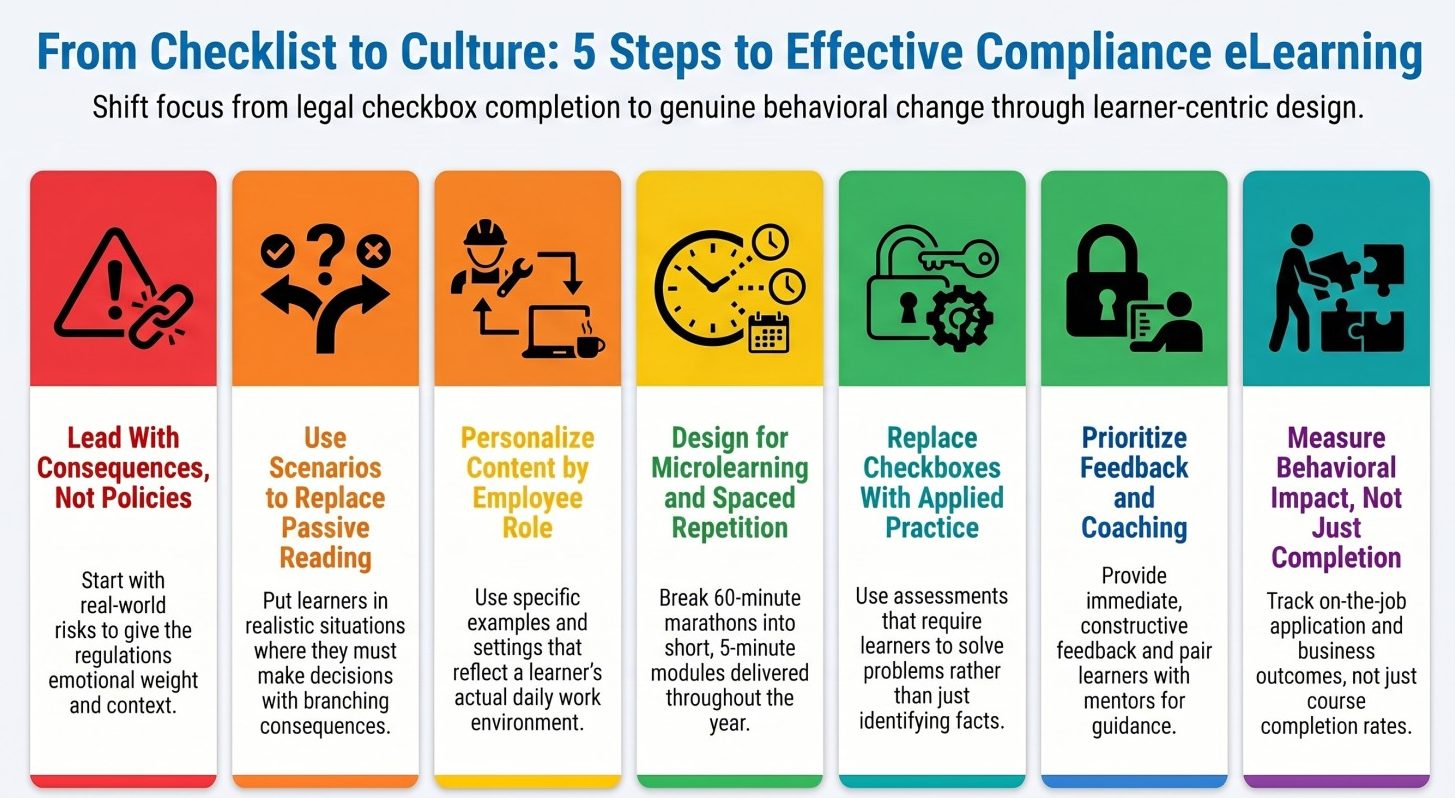
The single most powerful shift you can make in compliance eLearning design is starting with why it matters — not what the policy says.
Before presenting any rule, regulation, or requirement, show learners what happens when things go wrong. A realistic scenario of a data breach caused by a simple email error. A workplace injury that occurred because a safety protocol was skipped under time pressure. A harassment complaint that escalated because a manager did not respond appropriately.
When learners understand the real-world consequences first, the policy that follows has context, weight, and relevance. Consequently, retention improves significantly because the content connects to something emotionally meaningful, not just legally required.
Scenario-based learning is, without question, the most effective instructional format for compliance training eLearning. Instead of presenting a policy and asking learners to confirm they read it, scenario-based design places learners inside a realistic situation and asks them to make decisions.
For example, rather than stating “Employees must report suspected bribery to the compliance hotline,” a scenario-based module might present a situation where a supplier contact casually offers an expensive gift before a contract renewal — and asks the learner what they would do, with branching consequences for each choice.
This approach does three critical things simultaneously. It builds decision-making confidence in safe, low-stakes conditions. It exposes the gap between knowing a rule and applying it in context. And it makes the training memorable in a way that slides and bullet points never will.
Effective compliance training eLearning acknowledges that compliance risk is not uniform across an organisation. A frontline retail employee, a software engineer, a finance manager, and an HR business partner all face different compliance scenarios — even within the same regulatory framework.
Therefore, role-based compliance eLearning pathways significantly outperform one-size-fits-all programmes. When learners see examples, scenarios, and language that reflect their actual work environment, engagement increases, relevance is immediately clear, and application becomes far more natural.
Even simple personalisation — adjusting job titles, workplace settings, and scenario contexts by department — dramatically improves how seriously learners engage with compliance content.
Annual compliance training marathons are pedagogically ineffective. Research on how memory works consistently shows that shorter, spaced learning experiences produce significantly better retention than a single long session.
Rather than delivering 60 minutes of compliance content once a year, consider breaking it into six to eight focused microlearning modules of five to eight minutes each, deployed across the year at strategically relevant moments. A data privacy refresher before a system migration. A workplace safety module ahead of a high-traffic operational period. An anti-bribery reminder before a major procurement cycle.
This approach — known as spaced repetition — ensures compliance knowledge stays active in learners’ minds, not just checked off on an annual calendar.
If your compliance training assessment consists of ten multiple-choice questions that can be passed by any reasonably attentive adult in under three minutes, you are not assessing compliance understanding. You are generating completion data.
Effective compliance eLearning assessments are designed to evaluate application, not just recognition. That means scenario-based questions where learners must choose appropriate responses to realistic situations. It means assessments where choosing the wrong answer leads to a brief explanation of why — so the assessment itself becomes a learning moment, not just a gate.
Moreover, adaptive assessments that adjust question difficulty based on learner responses provide far more instructional value — and far more useful data for your compliance reporting.
Compliance training has a visual problem. Most modules look exactly like the legal documents they are based on — dense text, minimal imagery, corporate grey palettes, and stock photos of people shaking hands in glass-walled conference rooms.
Effective compliance eLearning development invests in a visual design approach that feels human, not institutional. Real-looking characters facing recognisable workplace situations. Clean, modern layouts that prioritise readability. Short video segments that show real consequences rather than describe them in paragraphs.
Visual design in compliance training is not cosmetic. It is a direct driver of learner engagement, credibility, and information processing.
Regulations change. Policies evolve. Industry standards are updated. One of the most underestimated challenges in compliance eLearning development is building content that can be updated quickly and cost-effectively when requirements shift.
From the very beginning, design your compliance eLearning with modular architecture — so individual sections can be updated without rebuilding entire courses. Maintain clear version control documentation. And work with your outsourcing partner to establish a rapid content refresh workflow that can respond to regulatory changes within days, not months.
Compliance training eLearning does not have to be the most dreaded item in your learning catalogue. When it is designed around learner understanding rather than legal coverage, built with scenario-based and role-specific content, delivered in spaced microlearning formats, and assessed with meaningful application questions — compliance training becomes something employees genuinely engage with.
The goal is not just a completed module. The goal is a workforce that actually understands what compliance means in their daily work, makes better decisions under pressure, and protects your organisation not because they had to click through a course — but because they genuinely understood why it matters.
That is the difference between compliance training that documents coverage and compliance training that drives culture.
At Learning Owl, we specialise in designing compliance training eLearning that goes far beyond checkbox completion. Our instructional design experts build scenario-based, role-personalised, visually engaging compliance programmes that your employees will actually remember and apply.
Whether you need to redesign an existing compliance library, build multilingual compliance content for a distributed workforce, or develop a rapid-refresh workflow for regulatory updates, Learning Owl has the expertise and production capability to deliver.
Let us build something your learners will not dread and your legal team will appreciate.
Compliance training eLearning is digital learning content designed to educate employees on laws, regulations, company policies, and industry standards relevant to their roles. It is important because it reduces legal and regulatory risk, builds a culture of ethical conduct, protects employees and customers, and demonstrates organisational accountability to regulators and auditors. When designed effectively, it goes beyond checkbox completion to drive genuine behavioural change.
Research consistently shows that shorter, focused modules produce better retention than long, comprehensive sessions. For compliance training eLearning, individual modules ideally range between five and fifteen minutes. If the total compliance curriculum covers significant ground, it is far more effective to break it into a series of focused microlearning modules deployed across the year than to deliver everything in a single annual session.
The most effective strategies for improving compliance training engagement include using scenario-based learning with realistic workplace situations, personalising content by role or department, replacing passive reading with interactive decision-making activities, using clean and human visual design, and incorporating spaced repetition through shorter modules deployed across the year rather than one long annual event. Each of these shifts moves compliance training from information delivery to genuine learning experience.
Compliance awareness refers to employees knowing that a policy or regulation exists. Compliance training goes significantly further — it builds understanding of why the policy exists, what it means in practical workplace situations, how to apply it correctly under real conditions, and what the consequences of non-compliance look like. Effective compliance training eLearning is designed to produce genuine understanding and behaviour change, not just documented awareness.
Compliance training should be reviewed at minimum annually, and updated immediately whenever relevant regulations change, internal policies are revised, or significant incidents reveal gaps in current content. Building modular eLearning architecture from the start makes rapid updates significantly easier and more cost-effective. Working with an experienced eLearning outsourcing partner who offers rapid content refresh workflows ensures your compliance content stays accurate and legally current.
Yes, and for organisations with multilingual or geographically distributed workforces, multilingual compliance eLearning is not optional — it is a legal and operational necessity. Effective multilingual compliance content requires not just translation but full localisation, ensuring that examples, scenarios, terminology, and regulatory references are accurate and culturally appropriate for each target region. Working with a partner experienced in eLearning translation and localisation is essential for compliance programmes that span multiple languages.
Measuring compliance training effectiveness requires looking beyond completion rates. Key indicators include assessment scores and improvement over time, behavioural metrics such as incident rates, audit findings, or policy violation frequency before and after training, learner feedback on content relevance and clarity, and manager observations of on-the-job behaviour change. The most meaningful measurement framework connects training outcomes directly to the compliance risks the training was designed to mitigate.
Most forms of compliance training are well-suited to eLearning delivery, particularly content that needs to reach large, distributed audiences consistently. Common compliance topics that deliver strong outcomes through eLearning include data privacy and GDPR, workplace health and safety, anti-harassment and code of conduct, anti-bribery and corruption, financial regulations and ethics, cybersecurity awareness, and industry-specific regulatory requirements. Scenario-based eLearning is particularly effective for topics involving ethical decision-making and judgement under pressure.
Thursday, 22Oct 2026
A new core banking platform, an ERP…

Monday, 19Oct 2026
Almost every employee has done it. You…

Thursday, 15Oct 2026
Engaging Technical Training Starts with a Simple…
Thursday, 22Oct 2026
A new core banking platform, an ERP…
Monday, 19Oct 2026
Almost every employee has done it. You…
Thursday, 15Oct 2026
Engaging Technical Training Starts with a Simple…
Thursday, 22Oct 2026
A new core banking platform, an ERP upgrade, a fresh CRM for the sales team or a new claims system for an insurer: every organisation goes through system changes, and…
Read More line_end_arrow_notch
Monday, 19Oct 2026
Almost every employee has done it. You open the annual compliance course, click "Next" until the quiz appears, guess your way to a pass mark, and close the window. Box…
Read More line_end_arrow_notch
Thursday, 15Oct 2026
Engaging Technical Training Starts with a Simple Shift Engaging technical training begins when employees stop seeing training as information they have to complete and start seeing it as knowledge they…
Read More line_end_arrow_notch