
Thursday, 17Sep 2026
The eLearning Brief That Saves Every Project: What to Document Before Development Starts
Six weeks into an eLearning development project,…
Monday, 17Aug 2026
Walk into any corporate office in Mumbai, Hyderabad, Bengaluru, or Chennai. Listen to how professionals actually talk to each other.
You will not hear pure English. You will not hear pure Hindi, Telugu, or Tamil. You will hear something fluid, natural, and entirely deliberate, a seamless blending of two or more languages within a single conversation, sometimes within a single sentence.
“Aaj ki meeting mein kya decide hua?” followed immediately by “The client wants the report by Friday.” Followed by “Theek hai, let’s divide the work.”
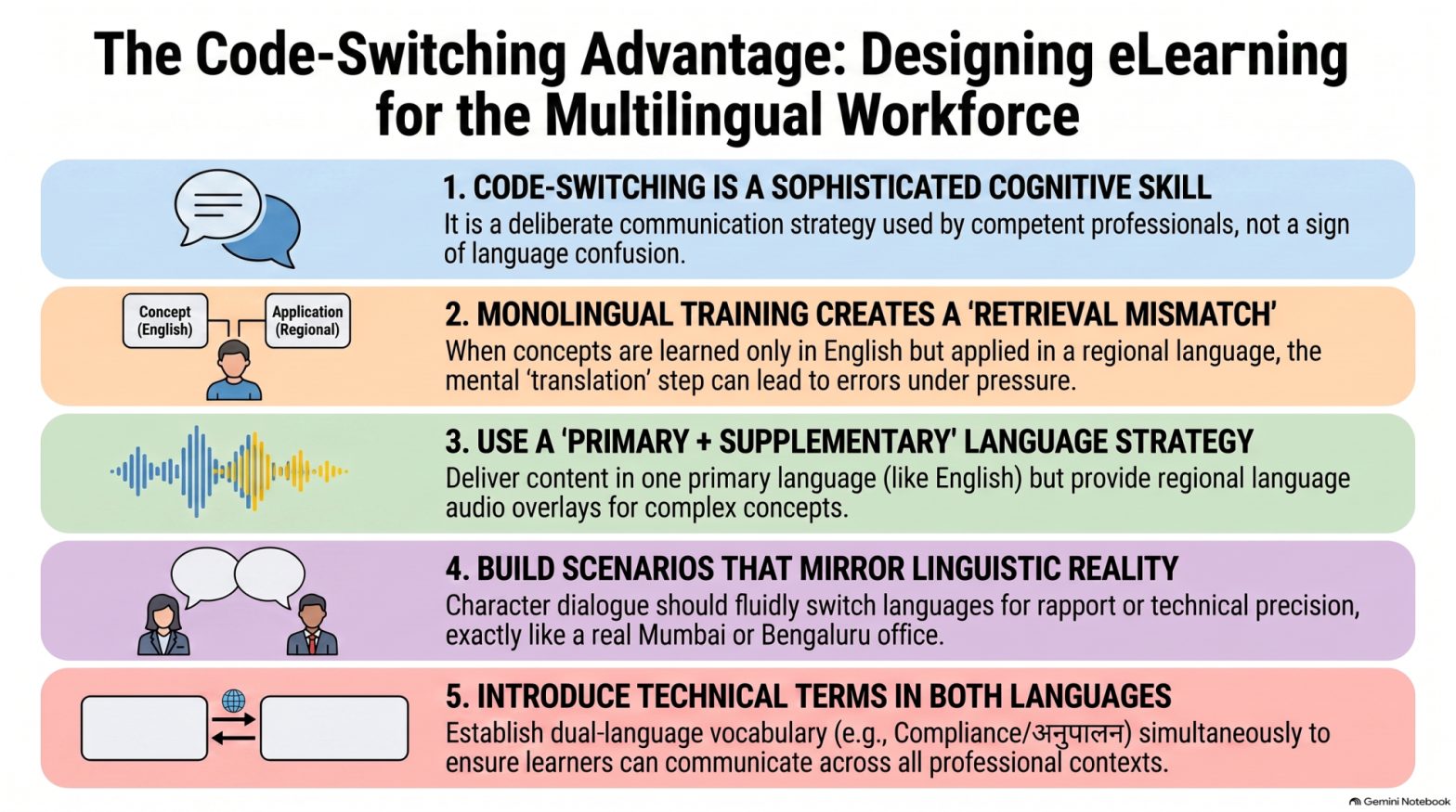
This is code-switching. And it is not a linguistic accident or a sign of incomplete proficiency in either language. It is a sophisticated, deliberate communication strategy used by highly competent multilingual speakers to navigate their professional and personal worlds simultaneously.
The problem is that most eLearning is designed for learners who think in one language and work in that same language. Consequently, when that eLearning reaches a code-switching learner, something subtle but significant goes wrong. The course feels slightly off. The language feels slightly foreign. The examples feel slightly misaligned with how this learner actually experiences their professional world.
This blog gives eLearning designers, L&D leaders, and K-12 publishers the complete framework for designing learning experiences that genuinely serve code-switching learners, in India and globally.
Before designing for code-switching learners, designers must understand what code-switching actually is.
Code-switching is the practice of alternating between two or more languages or language varieties within a single conversation, document, or interaction, depending on topic, context, relationship, or communicative purpose.
Furthermore, research in sociolinguistics consistently shows that code-switching follows systematic rules, not random mixing. Speakers switch at grammatically predictable points. They switch for specific social and rhetorical purposes. And they switch with a precision that requires genuine mastery of both language systems.
Consequently, designing eLearning that ignores code-switching is not a neutral design choice. It is a design choice that makes the learning experience feel foreign to a significant proportion of the target learner population.
Understanding the scale of the code-switching learner population in India is essential for L&D leaders making design investment decisions.
India has the second largest English-speaking population in the world. However, the vast majority of those English speakers do not use English as their primary home language or their primary cognitive language. They use a regional language — Hindi, Tamil, Telugu, Marathi, Bengali, Kannada, Malayalam, or others, as the language in which they think, dream, and process emotion.
English, for most of India’s professional workforce, is a language of work, acquired formally, used professionally, but rarely the language of deepest cognitive processing.
None of these learner populations is served well by eLearning that forces a choice between full English delivery and full regional language delivery. Both options misrepresent how these learners actually process and apply information.
Designing for code-switching learners is not simply a matter of translating content into two languages. It requires understanding five specific design challenges that this learner population creates.
Code-switching learners frequently acquire technical knowledge in English through training, documentation, and professional reading, but apply that knowledge in a regional language context. This creates a retrieval mismatch.
When learning is encoded in English but application must happen in Tamil or Hindi, the retrieval pathway is longer and less reliable. The learner must translate consciously or unconsciously, at the moment of application. Under pressure, this translation step can fail.
Most eLearning forces encoding in only one language. It either teaches in English, creating retrieval gaps for regional language application or teaches in a regional language, creating gaps for English-medium documentation and reporting requirements.
Neither approach serves the code-switching learner’s actual cognitive reality.
Code-switching learners in India inhabit professional contexts that are themselves code-switched. Their workplaces use English terminology embedded in regional language conversation. Their customers switch languages mid-interaction. Their team meetings move fluidly between English agenda points and regional language discussion.
eLearning scenarios that depict either a purely English professional environment or a purely regional language professional environment feel slightly unrealistic to code-switching learners, because neither matches their actual experience.
When scenarios feel unrealistic, learners engage with them as training exercises rather than professional practice. The transfer of learning from the scenario to the real workplace weakens significantly.
Many technical terms exist in two forms in a code-switching learner’s professional vocabulary. “Compliance” and “अनुपालन” (anupaalan). “Assessment” and “मूल्यांकन” (mulyaankan). “Dashboard” and “डैशबोर्ड” (transliterated). The learner uses both, often in the same sentence, depending on who they are talking to.
eLearning that uses only the English term creates a gap when the learner must use or recognise the regional language equivalent. eLearning that uses only the regional language equivalent creates a gap when the learner must use the English term in documentation or reporting.
Neither monolingual approach builds the dual-language professional vocabulary that code-switching learners actually need to do their jobs effectively.
English and regional languages carry different register associations in Indian professional contexts. English is typically associated with formal, professional, hierarchical communication. Regional languages carry more warmth, directness, and relational intimacy.
Code-switching learners use these register differences deliberately. They switch to English to signal formality, authority, or precision. They switch to a regional language to signal rapport, inclusivity, or emotional authenticity.
eLearning that delivers all content in a single register, regardless of which language it uses, misses the register intelligence that code-switching learners apply in their real professional practice. The eLearning feels tonally flat relative to the learner’s actual communicative experience.
Assessment in a single language creates an unfair cognitive burden for code-switching learners who have processed the content bilingually.
A learner who understood a concept by encoding it bilingually, anchoring it in both their English professional vocabulary and their regional language cognitive framework, may perform poorly on a monolingual assessment not because they did not learn, but because the assessment language does not match their primary encoding language for that concept.
Monolingual assessment systematically underpredicts the actual competence of code-switching learners, creating false negatives that misrepresent what the learner actually knows and can do.
These eight principles form the practical design framework for eLearning that genuinely serves code-switching learners. Each principle directly addresses one or more of the five challenges above.
Every eLearning module must have a clearly defined primary delivery language. However, that primary language choice must be accompanied by deliberate supplementary language support, not as an accessibility afterthought but as a core instructional tool.
It gives learners access to content in the language that best supports their understanding of each specific element, rather than forcing full encoding in a single language that may not be the most efficient encoding language for every concept.
Transitional note: Once the primary language is established, the next design priority shifts to how scenarios and examples are constructed.
Scenarios for code-switching learners should reflect the linguistic reality of the learner’s actual workplace, which means the scenario world itself should be code-switched where appropriate.
When scenarios mirror the learner’s actual professional context including its linguistic complexity, learners engage with them as realistic rather than as simplified training simulations. Consequently, the decision-making practice within the scenario transfers more effectively to real-world performance.
Transitional note: Realistic scenarios require equally realistic character dialogue, which brings us to the next principle.
Character dialogue in eLearning scenarios for code-switching learners should include appropriate, natural code-switching, not because it is novel or creative, but because it is accurate.
Authentic dialogue builds scenario believability. Scenario believability is the prerequisite for the psychological engagement that makes scenario-based learning effective.
Every technical term introduced in a module for code-switching learners should be introduced in both its English form and its most commonly used regional language equivalent, simultaneously, at first use, with consistent application thereafter.
Before writing begins, establish a terminology policy that answers three questions for every key term:
Dual-language terminology introduction directly addresses the terminology dual-identity problem. It builds the complete professional vocabulary that code-switching learners need, not half of it.
Audio in eLearning for code-switching learners is not simply a narration track. It is a deliberate tool for delivering content in the language that serves each element of the learning experience most effectively.
Strategic audio delivery across both language channels mirrors the way code-switching learners actually receive and process information in their professional environments, making the learning experience cognitively natural rather than cognitively effortful.
Assessment for code-switching learners must be designed to measure genuine competence, not language performance in a single code. This requires deliberate assessment design choices that give code-switching learners the opportunity to demonstrate knowledge in the language they encoded it in.
Assessment that matches the learner’s encoding context produces more accurate competence measurement. More accurate competence measurement produces better L&D data, which supports better training design decisions.
Performance support tools for code-switching learners, job aids, quick reference guides, decision trees, checklists, must be available in both the English and regional language forms that the learner will need at the moment of application.
A learner who completed training in English but must apply the learning in a regional language customer interaction needs a job aid that bridges both languages. A learner who processed a concept in regional language but must document in English needs a reference that provides both forms.
Performance support at the moment of application closes the retrieval gap that monolingual training creates for code-switching learners. It makes correct behaviour easier at the exact moment the learner needs to perform it.
No eLearning designed for code-switching learners should be finalised without testing with actual members of the target learner population, specifically evaluating whether the language design, scenario authenticity, and terminology treatment feel natural.
The authenticity of code-switched content can only be evaluated by people who actually code-switch in the contexts being depicted. Internal review by L&D teams, however capable, cannot replicate this evaluation.
Different training contexts require different applications of the code-switching design framework.
Compliance terminology is overwhelmingly English. Application is frequently in regional language customer or team interactions.
Sales process documentation is in English. Customer interactions are in regional language. The learner must bridge both fluently.
Safety procedures are documented in English. Shopfloor communication is in regional language. The gap between these two creates genuine safety risk.
Leadership frameworks are delivered in English. Leadership practice happens in code-switched team environments.
Designing eLearning for code-switching learners is not a niche design challenge. It is the mainstream design challenge for L&D teams and publishers working with India’s professional and educational workforce.
Code-switching is not a deficit. It is a sophisticated cognitive and communicative skill that represents the daily reality of millions of Indian learners. eLearning that ignores it produces content that feels slightly foreign, slightly misaligned, and slightly less trustworthy than the learner’s actual professional world.
The eight principles in this guide, primary language with supplementary support, code-switched scenarios, authentic dialogue, dual-language terminology, strategic audio, bilingual assessment, bilingual performance support, and learner testing, form a complete framework for closing that gap.
Apply them consistently. Test them rigorously. And build learning experiences that meet code-switching learners exactly where they are, in the fluid, intelligent, beautifully complex linguistic reality they inhabit every working day.
At Learning Owl, we understand that India’s professional and educational learners do not live in a single language. Our multilingual eLearning development team builds content that genuinely serves code-switching learners, with vernacular-first design capability, bilingual scenario development, dual-language terminology architecture, and regional language audio production across Hindi, Tamil, Telugu, Marathi, Bengali, Kannada, and more.
Our multilingual and code-switching eLearning services include bilingual eLearning content development, code-switched scenario design, dual-language terminology frameworks, regional language audio narration, bilingual performance support resources, multilingual assessment design, and vernacular medium K-12 curriculum development.
Whether you are building corporate compliance training for a pan-India workforce, sales enablement for a code-switching field team, or K-12 curriculum for learners navigating regional language and English instruction simultaneously, Learning Owl builds learning that speaks to the whole learner, not just the professional half.
Because your learners think in more than one language. Their training should too.
Code-switching in the context of eLearning design refers to the linguistic practice of alternating between two or more languages within a single learning interaction and the challenge of designing eLearning that genuinely serves learners who do this naturally. Code-switching learners are professionals or students who think primarily in one language but work, study, or communicate professionally in another or who move fluidly between multiple languages depending on context, topic, or relationship. In India, this describes the majority of the educated professional and student population. Designing eLearning for code-switching learners requires deliberate language strategy, bilingual content architecture, code-switched scenario design, and assessment approaches that measure competence rather than language performance.
Code-switching is common in India’s professional workforce because the majority of India’s educated professionals acquired English as an additional language in formal education, while using a regional language as their primary cognitive, emotional, and social language. English functions as a professional lingua franca for documentation, reporting, and cross-regional communication. Regional languages function as the medium for team interaction, customer communication, and conceptual processing. Most Indian professionals operate in both linguistic modes daily, switching between them based on context, relationship, and communicative purpose. This is not a proficiency gap. It is a sophisticated multilingual competence that effective eLearning design should respect and support rather than attempt to eliminate.
The answer is neither, at least not exclusively. eLearning for code-switching learners should be designed with a clearly defined primary delivery language chosen based on the specific learning objectives, the professional application context, and the linguistic profile of the target learner population. That primary language choice should then be supported by supplementary language resources, regional language audio overlays, bilingual glossaries, dual-language job aids, that give learners access to content in the language that best supports their encoding and retrieval of each specific element. Forcing a binary choice between full English and full regional language delivery misrepresents the actual cognitive reality of code-switching learners and produces suboptimal learning outcomes in both options.
Designing fair assessments for code-switching learners requires a clear separation between subject matter competence and language performance. Present assessment items in the language that best matches how learners encode the relevant content. Where possible, provide items in both the primary delivery language and the learner’s strongest regional language. Use scenario-based assessment items set in code-switched professional contexts to measure how well learners apply knowledge in real performance environments. This approach provides a more valid measure of competence than monolingual recall items for this learner population. Finally, consider the additional cognitive load of bilingual processing when interpreting results and setting pass thresholds.
The types of eLearning content most significantly affected by code-switching learner needs are those where the gap between the language of training and the language of application is widest. Compliance training, delivered in English but applied in regional language customer interactions, is highly affected. Sales and customer service training, where process documentation is English but customer interactions are regional language, is highly affected. Safety training, where English-language procedures must be applied in regional language shopfloor communication, is critically affected because the application gap creates genuine safety risk. Leadership and communication training is deeply affected because it requires practice in the actual code-switched communicative contexts where leadership behaviours must be demonstrated.
Technical terminology in eLearning for code-switching learners needs an explicit terminology policy, which teams should establish before content writing begins. The policy should cover three categories of terms. First, for terms with accurate, widely used regional equivalents, introduce both forms together the first time they appear. Second, for terms commonly used in English within regional-language professional contexts, introduce the English term first, followed by a regional-language explanation. Finally, for proper nouns, international standards, and brand names without suitable regional equivalents, retain the English term and provide a pronunciation guide. Apply this policy consistently across all modules. Before finalisation, teachers or practitioners from the target learner population should also validate the terminology.
Yes, and in fact, scenarios that include natural code-switching feel significantly more authentic to code-switching learners than scenarios that force a single language throughout. To make this effective, code-switching should be grounded in the same situational logic that guides it in real life. For example, characters may switch to a more formal language for official statements. Similarly, they may use the regional language to build rapport, English for technical precision, and the regional language again for emotional authenticity. In this way, code-switching feels systematic and purposeful rather than random. Moreover, it reflects how people naturally communicate across different situations. Finally, character dialogue should be tested with actual members of the target learner population before finalisation. This helps evaluate whether the code-switching feels natural and authentic, rather than forced or performative.
Standard bilingual eLearning typically offers the same content in two separate language versions. For example, there may be an English version and a regional language version. The learner chooses one at the outset and completes the course in that language throughout. However, eLearning for code-switching learners is architecturally different. It does not ask learners to choose one language and stay with it. Instead, it reflects how they actually think and communicate. For instance, the content may be delivered primarily in one language, with strategic support in another. Scenarios can also reflect code-switched professional environments. Terminology can be introduced in both language forms. In addition, bilingual performance-support resources can be provided. Therefore, the design philosophy shifts from “Which language do you want this in?” to “How do we design for the way you actually think and work?”
Thursday, 17Sep 2026
Six weeks into an eLearning development project,…

Tuesday, 8Sep 2026
A manufacturing plant in Pune deployed a…

Thursday, 3Sep 2026
Most eLearning modules open with a slide…
Thursday, 17Sep 2026
Six weeks into an eLearning development project,…
Tuesday, 8Sep 2026
A manufacturing plant in Pune deployed a…
Thursday, 3Sep 2026
Most eLearning modules open with a slide…
Thursday, 17Sep 2026
Six weeks into an eLearning development project, the stakeholder sends a message that every instructional designer recognises immediately. "Actually, we need to include the new onboarding policy as well. And…
Read More line_end_arrow_notch
Tuesday, 8Sep 2026
A manufacturing plant in Pune deployed a mandatory safety training module last year. Every eligible worker completed it. Completion rates hit 98 percent. The assessment pass rate was 91 percent.…
Read More line_end_arrow_notch
Thursday, 3Sep 2026
Most eLearning modules open with a slide that looks something like this: "By the end of this module, you will understand the importance of data privacy in customer communications." That…
Read More line_end_arrow_notch