
Thursday, 22Oct 2026
Software Rollout Training: How to Design eLearning That Gets Employees Productive on a New System from Day One
A new core banking platform, an ERP…

Thursday, 23Apr 2026
Content Treadmill in EdTech is one of the most overlooked challenges facing publishers and digital learning companies today. While the demand for continuous content creation is increasing, many organisations find themselves producing more but achieving less in terms of learning impact.
At first glance, high-volume content production appears to be a sign of growth. However, over time, this constant push to create more lessons, modules and updates leads to fatigue, inconsistent quality and shallow curriculum depth.
As EdTech platforms expand across grades, subjects and geographies, the pressure to keep feeding the content pipeline intensifies. Without a structured approach, the content treadmill becomes difficult to sustain.
The Content Treadmill in EdTech refers to the ongoing cycle of producing large volumes of digital learning content to meet platform demands, user expectations and market competition.
This cycle typically includes:
While these activities are essential for growth, they often create a system where teams are always producing but rarely optimising.
As a result, organisations focus on output rather than educational effectiveness.

Understanding the root causes of the Content Treadmill in EdTech is critical for addressing it effectively.
EdTech companies are expected to scale rapidly. Investors, users and schools demand:
This creates a production-driven mindset where volume becomes a key metric of success.
Many EdTech platforms rely on continuous content updates to maintain engagement. Without new material, user activity may decline.
As a result, companies prioritise frequent content releases, often at the cost of depth and refinement.
In many organisations, content development operates as a project rather than a system.
Without:
Content production becomes repetitive and resource-intensive.
Product teams often focus on features, user experience and engagement metrics, while academic teams focus on curriculum depth.
When these two functions are not aligned, content production may prioritise speed over instructional quality.
While the Content Treadmill in EdTech may initially support growth, its long-term impact can be significant.
When teams are constantly producing new content, they have less time to refine existing modules.
This leads to:
High-speed production often results in more errors, requiring additional review and correction cycles.
This slows down delivery and increases operational complexity.
Content teams working under constant pressure to deliver may experience fatigue, reducing creativity and productivity over time.
Without standardisation, learners may encounter variations in quality across modules, subjects or grades.
This affects user trust and platform credibility.
As content volume increases, managing updates, revisions and quality control becomes more difficult.
The system begins to strain under its own weight.
At the heart of the Content Treadmill in EdTech lies a fundamental conflict between volume and depth.
Producing more content increases platform coverage.
However, sustaining curriculum depth requires time, expertise and structured development.
When organisations prioritise volume alone, depth suffers. Conversely, focusing only on depth may limit scalability.
The solution lies in balancing both through a structured content production model.
To overcome the Content Treadmill in EdTech, organisations must shift from ad-hoc content creation to a structured production engine.
Creating standard templates for lessons, interactions and assessments ensures consistency and reduces production time.
Standardisation allows teams to focus on improving content quality rather than reinventing formats.
Breaking content into smaller, reusable modules enables flexibility and scalability.
Modular content can be:
A strong instructional design framework ensures that content is structured for learning effectiveness.
This includes:
Quality assurance should not be limited to final reviews.
Instead, organisations should introduce:
This reduces errors and improves consistency.
Content production should be driven by curriculum priorities rather than platform demands alone.
This ensures that learning outcomes remain central to content development.
Automation and AI can support content creation, but they should not replace instructional design.
Technology should accelerate workflows while maintaining pedagogical integrity.
A sustainable approach to content development requires treating content as a system rather than a series of isolated projects.
Key characteristics of a sustainable system include:
When these elements are in place, organisations can move away from the Content Treadmill in EdTech and towards structured growth.
Organisations that successfully overcome the Content Treadmill in EdTech gain several advantages.
They can:
Most importantly, they shift from reactive content production to proactive curriculum development.
The Content Treadmill in EdTech is not just a production challenge; it is a strategic issue that affects learning quality, scalability and long-term growth.
While continuous content creation is necessary, it must be supported by structured systems, strong instructional design and clear alignment with academic goals.
By moving from volume-driven production to a production engine approach, organisations can sustain both scale and depth in their digital learning offerings.
At Learning Owl, we help publishers and EdTech companies move beyond the Content Treadmill in EdTech by building structured, scalable content production systems.
Our pedagogy-first approach ensures that curriculum depth is maintained while enabling efficient large-scale content development. With strong instructional design frameworks, modular content strategies and layered quality assurance, Learning Owl helps organisations create digital learning ecosystems that are both sustainable and effective.
If your content strategy feels like a constant race without long-term stability, it may be time to rethink your execution model.
The Content Treadmill in EdTech refers to the continuous cycle of producing large volumes of content to meet platform and market demands, often at the cost of quality and sustainability.
Many companies lack structured workflows, standardisation and modular content strategies, making it difficult to scale without increasing workload and complexity.
It often leads to shallow content, reduced conceptual clarity and inconsistent learning experiences, which impact student understanding.
A production engine approach that includes standardisation, modularisation and strong instructional design helps balance scale and quality.
AI can support content creation, but it cannot replace instructional design. A hybrid approach combining AI and human expertise is more effective.
By implementing structured workflows, reusable content modules and strong quality assurance processes, publishers can scale without compromising depth.
Thursday, 22Oct 2026
A new core banking platform, an ERP…

Monday, 19Oct 2026
Almost every employee has done it. You…
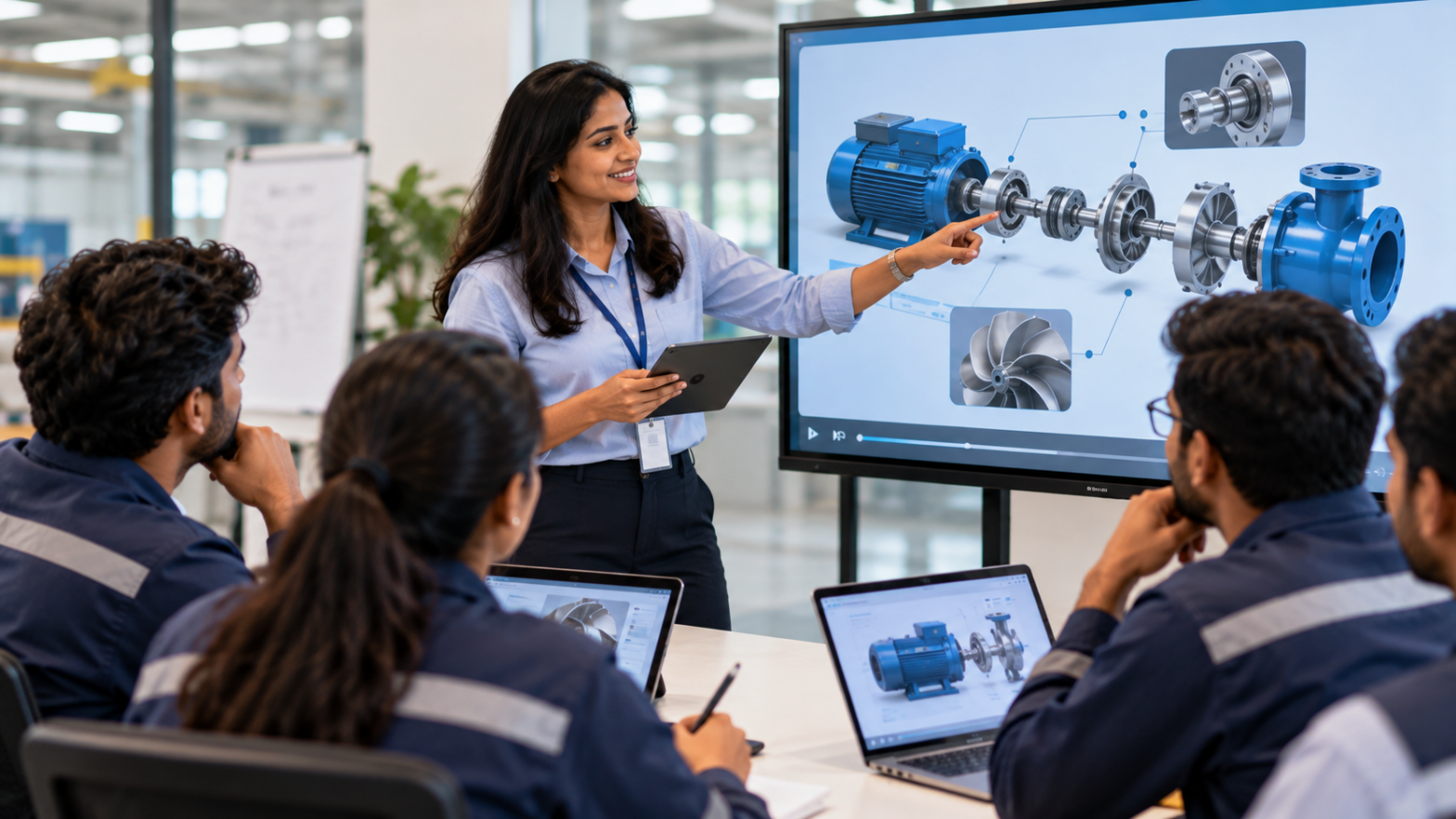
Thursday, 15Oct 2026
Engaging Technical Training Starts with a Simple…
Thursday, 22Oct 2026
A new core banking platform, an ERP…
Monday, 19Oct 2026
Almost every employee has done it. You…
Thursday, 15Oct 2026
Engaging Technical Training Starts with a Simple…
Thursday, 22Oct 2026
A new core banking platform, an ERP upgrade, a fresh CRM for the sales team or a new claims system for an insurer: every organisation goes through system changes, and…
Read More line_end_arrow_notch
Monday, 19Oct 2026
Almost every employee has done it. You open the annual compliance course, click "Next" until the quiz appears, guess your way to a pass mark, and close the window. Box…
Read More line_end_arrow_notch
Thursday, 15Oct 2026
Engaging Technical Training Starts with a Simple Shift Engaging technical training begins when employees stop seeing training as information they have to complete and start seeing it as knowledge they…
Read More line_end_arrow_notch