
Introduction
Corporate eLearning Content Development Outsourcing is becoming a strategic decision for organisations that want to scale learning efficiently without building large internal training teams.
As companies grow, so does the need for employee training. New hires must be onboarded, teams must learn new tools, compliance regulations must be followed and employees must continuously upgrade their skills.
Many organisations initially attempt to build training content internally. However, they soon realise that creating high-quality training requires instructional design expertise, multimedia development, technology tools and a structured development process.
This raises an important question for learning leaders:
Should organisations build corporate eLearning content internally or rely on external partners?
Understanding the real cost behind both approaches helps companies make the right decision.
Understanding Corporate eLearning Content Development
Before comparing the two approaches, it is important to understand what corporate eLearning content development actually involves.
Developing modern training programmes requires several specialised capabilities, including:
- Instructional design
- Content writing
- Visual and multimedia design
- Interactive eLearning development
- Scenario-based learning design
- Assessment creation
- Learning Management System integration
When organisations attempt to build all of this internally, they must invest in people, tools, processes and time.
This is why corporate eLearning content development outsourcing has become increasingly popular among companies looking to develop high-quality learning programmes efficiently.
The True Cost of Building Corporate Training Content In-House
At first glance, developing training internally may seem cost-effective. However, the hidden costs often become significant over time.
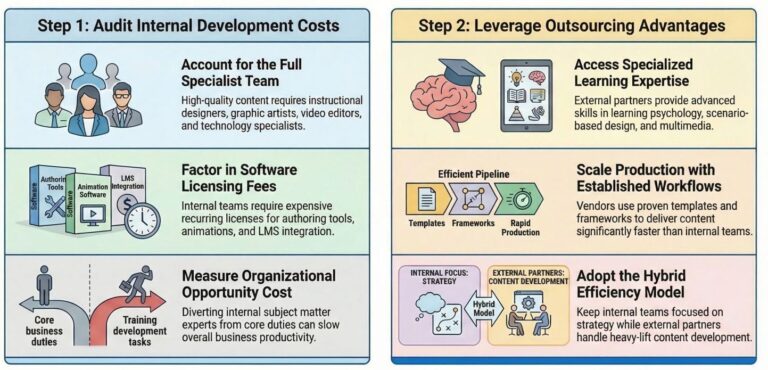
Hiring a Complete Learning Team
High-quality training content requires a specialised team.
An internal corporate learning team may include:
- Instructional designers
- Content writers
- Graphic designers
- eLearning developers
- Video editors
- Voice artists
- Learning technology specialists
Recruiting and maintaining such a team requires significant investment. Salaries, benefits and ongoing training costs can quickly add up.
In comparison, eLearning content development outsourcing allows organisations to access the same expertise without hiring a large internal team.
Technology and Software Costs
Modern eLearning development relies on advanced tools such as:
- Articulate Storyline
- Articulate Rise
- Adobe Captivate
- Video editing software
- Animation tools
- Learning Management Systems
Licences for these tools can be expensive, especially when used by multiple team members.
By choosing outsourcing, organisations gain access to these technologies through their eLearning content development partner without investing in software licences.
Development Time
Creating effective learning content is a structured process that involves:
- Training needs analysis
- Instructional design
- Storyboarding
- Visual design
- Course development
- Reviews and revisions
- Deployment
Internal teams that are inexperienced in this process may take longer to develop training programmes.
With outsourcing, experienced vendors already have established workflows that allow faster development.
Opportunity Cost
When internal teams spend time creating training content, they are often diverted from their primary responsibilities.
Subject matter experts, managers and HR teams may spend weeks reviewing training materials.
This hidden cost can slow down organisational productivity.
Through corporate eLearning content development outsourcing, internal teams can focus on strategy while learning partners handle development.
The Advantages of Corporate Training Content Outsourcing
For many organisations, outsourcing training content offers several strategic advantages.
Access to Specialised Expertise
Professional learning partners specialise in:
- Instructional design
- Learning psychology
- interactive training development
- scenario-based learning
- multimedia production
Through Outsourcing, organisations gain access to experienced professionals who know how to design engaging and effective training.
Faster Training Development
Experienced vendors already have structured development processes, templates and content frameworks.
This allows them to produce high-quality courses much faster than many internal teams.
Speed is especially important when organisations need training for:
- Product launches
- System upgrades
- Compliance changes
- Policy updates
Outsourcing helps organisations respond quickly to these needs.
Scalability
Training needs often increase rapidly as organisations grow.
An internal team may struggle to handle sudden increases in training demand.
However, with eLearning content development outsourcing, organisations can scale development easily by leveraging external teams.
Consistent Quality
Professional vendors maintain quality standards across projects.
They follow structured instructional design processes and quality assurance procedures.
This ensures that training developed through corporate eLearning content development outsourcing maintains consistency and effectiveness.
When Should Companies Build Training Internally?
Although outsourcing offers many advantages, building training internally may be suitable in certain situations.
For example:
- When organisations produce training content frequently throughout the year
- When content requires constant updates
- When the company already has a strong internal learning team
In such cases, internal teams can manage smaller projects while using outsourcing for large or complex training programmes.
When Outsourcing Becomes the Smarter Choice
Corporate Training Content Outsourcing becomes the better option when organisations need:
- Large-scale training programmes
- Rapid development timelines
- High-quality interactive eLearning
- specialised instructional design expertise
- multimedia and interactive content
Outsourcing also works well when companies are transitioning from classroom training to digital learning environments.
Hybrid Model: The Best of Both Worlds
Many successful organisations adopt a hybrid model.
In this approach:
- Internal teams manage training strategy and subject matter expertise
- External partners handle content design and development
This allows organisations to combine internal knowledge with professional learning design capabilities.
The hybrid model is becoming a preferred approach for outsourcing in many modern organisations.
The Current Landscape of Corporate Training Content Development
Corporate learning has already moved far beyond traditional training models. Today, organisations are adopting modern learning strategies that prioritise flexibility, personalisation and measurable outcomes.
Several approaches are now standard practice in corporate eLearning content development outsourcing and digital learning development.
AI-Enhanced Learning Development
Artificial intelligence is already playing an important role in eLearning content development and digital learning design.
AI tools help accelerate:
- Content creation
- Learning personalisation
- Skill-gap analysis
- Adaptive learning pathways
Many organisations are already using AI to recommend courses based on employee roles, performance data and learning history.
Microlearning
Microlearning is no longer an emerging concept. It has become one of the most widely used formats in corporate eLearning modules today.
Short, focused learning modules allow employees to:
- learn quickly during busy work schedules
- retain information more effectively
- access training exactly when they need it
Modern Corporate eLearning content development outsourcing projects frequently prioritise microlearning modules over long, traditional courses.
Data-Driven Learning
Learning analytics now play a central role in corporate training strategies.
Through Learning Management Systems and analytics dashboards, organisations can measure:
- course completion rates
- learner engagement
- assessment performance
- skill improvement trends
This data helps organisations continuously improve their training programmes and maximise the impact of eLearning content development outsourcing.
Continuous Learning Ecosystems
Corporate training is no longer limited to occasional workshops or annual training programmes.
Many organisations are now building continuous learning ecosystems, where employees have ongoing access to digital learning resources, knowledge libraries and skill development pathways.
Through outsourcing, organisations can consistently expand and update these learning ecosystems to keep pace with changing business needs.
Conclusion
The decision between building eLearning modules internally and Outsourcing Corporate eLearning Content Development is not simply about cost.
It is about efficiency, scalability, expertise and long-term learning impact.
Organisations that carefully evaluate the real costs behind internal development often discover that outsourcing allows them to produce better training faster while maintaining operational flexibility.
If your organisation is planning to scale learning programmes or convert classroom training into engaging digital experiences, Learning Owl can support your journey by designing impactful training content that aligns with your business goals.
Because effective corporate training is not just about delivering information.
It is about empowering employees with the knowledge and skills they need to perform, grow and succeed.
FAQs: Corporate eLearning Content Development Outsourcing
-
What is Corporate eLearning Content Development Outsourcing?
Corporate eLearning Content Development Outsourcing refers to hiring specialised learning partners to design and develop digital training programmes for employees. These partners create instructional design frameworks, interactive eLearning modules, assessments, simulations and multimedia learning experiences that organisations deploy through their Learning Management Systems.
This approach allows companies to access expert instructional designers, developers and learning strategists without building a large internal training team.
-
Why do organisations choose Corporate eLearning Content Development Outsourcing?
Many organisations choose outsourcing to scale training efficiently and improve learning quality.
Common reasons include:
- Access to experienced instructional designers
- Faster development of training programmes
- Reduced internal workload for HR and L&D teams
- Cost-effective learning development
- Ability to create highly interactive digital learning experiences
Outsourcing enables organisations to deliver high-quality learning programmes while focusing internal teams on strategic initiatives.
-
What types of training can be developed through Corporate eLearning Content Development Outsourcing?
A wide range of corporate training programmes can be created through Corporate eLearning Content Development Outsourcing, including:
- Employee onboarding programmes
- Compliance and regulatory training
- Product and sales training
- Leadership and soft skills training
- Technical and software training
- Customer service training
Professional learning partners convert subject matter expertise into structured, engaging and interactive digital learning content.
-
How much does Corporate eLearning Content Development Outsourcing cost?
The cost of outsourcing depends on several factors such as:
- Length of the training programme
- Level of interactivity and multimedia
- Number of learning modules
- Complexity of instructional design
- Custom visual design or animation
In many cases, outsourcing reduces overall development costs compared to maintaining a full internal eLearning development team.
-
How long does Corporate eLearning Content Development Outsourcing take?
The timeline for Corporate eLearning Content Development Outsourcing varies depending on the complexity of the training.
Typical development timelines include:
- Microlearning modules: 1–2 weeks
- Standard eLearning courses: 3–6 weeks
- Complex interactive programmes: 6–12 weeks
Experienced outsourcing partners often deliver training faster due to established development processes and specialised teams.
-
What should organisations look for in a Corporate eLearning Content Development Outsourcing partner?
When selecting a vendor for eLearning Content Development Outsourcing, organisations should evaluate:
- Expertise in instructional design
- Experience in corporate learning projects
- Portfolio of interactive eLearning courses
- Ability to create scenario-based learning
- Strong project management processes
- Scalability for large training programmes
Choosing the right partner ensures training programmes are engaging, effective and aligned with business objectives.
-
What role does instructional design play in Corporate eLearning Content Development Outsourcing?
Instructional design is a critical component of Corporate eLearning Content Development Outsourcing because it ensures eLearning content is structured to maximise learning outcomes.
Instructional designers:
- Define learning objectives
- Structure content logically
- Design interactive learning activities
- Create assessments to measure knowledge
This process transforms complex information into engaging and effective learning experiences.
-
How can L&D teams measure the success of Corporate eLearning Content Development Outsourcing?
Organisations measure the effectiveness of Outsourcing through learning analytics and performance metrics such as:
- Course completion rates
- Assessment scores
- Learner engagement levels
- Knowledge retention
- Employee performance improvement
These metrics help L&D teams evaluate training impact and continuously improve learning programmes.
-
Is Corporate eLearning Content Development Outsourcing better than building training internally?
The choice depends on organisational needs.
Internal teams are useful for managing learning strategy, while outsourcing is often more effective for:
- large-scale digital training programmes
- interactive eLearning development
- specialised instructional design projects
- rapid training rollouts
Many organisations adopt a hybrid model where internal teams manage strategy and external partners handle development.
-
How does Corporate eLearning Content Development Outsourcing improve employee learning?
Through Outsourcing, organisations can design structured and engaging learning experiences that improve employee performance.
Effective digital learning programmes help employees:
- acquire job-specific knowledge
- practise real-world workplace scenarios
- access training anytime and anywhere
- learn at their own pace
This leads to better skill development, improved productivity and stronger organisational performance.