Digital transformation is easy to announce. Execution is harder to sustain.
K-12 Curriculum Digitisation has become a strategic necessity for publishers and EdTech companies. It is no longer a future-facing initiative but a present-day survival mandate. Yet behind confident boardroom presentations and ambitious digital roadmaps lies a difficult reality: most curriculum digitisation projects stall midway, launch late or go live in a pedagogically diluted form.
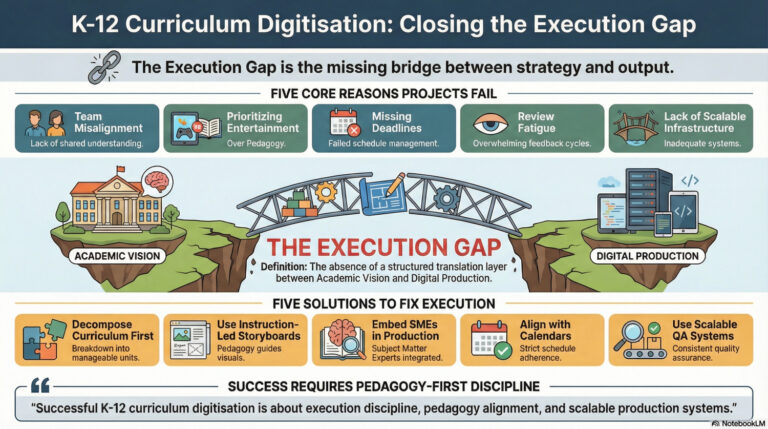
Surprisingly, these failures are rarely caused by a lack of funding or technology. The core issue is far more structural. It is the execution gap between academic vision and digital production.
Understanding this gap is the first step towards building sustainable, scalable K-12 Curriculum Digitisation models.
K-12 Curriculum Digitisation Fails More Often Than It Succeeds And It’s Not Because of Technology
Many organisations approach K-12 Curriculum Digitisation with a simplified operational assumption. They believe digitisation means taking a textbook, adding a voiceover, inserting animations and uploading the module to an LMS. While this approach may create visually appealing outputs, it does not transform curriculum into structured digital learning.
Curriculum is not static content. It is structured learning architecture built on cognitive sequencing, assessment alignment, concept progression and pedagogical intent. When instructional redesign is skipped, the outcome is often over-animated yet under-explained modules, fragmented learning journeys, increased review cycles, delayed launches and frustrated academic stakeholders.
Technology can amplify quality, but it cannot compensate for weak instructional foundations. Sustainable K-12 Curriculum Digitisation must begin with academic integrity.
The Five Core Reasons K-12 Curriculum Digitisation Projects Fail
-
Misalignment Between Academic Teams and Production Teams
A primary failure point in K-12 Curriculum Digitisation is the disconnect between those who design curriculum and those who execute digital production. Academic leaders think in terms of learning objectives, Bloom’s taxonomy levels and assessment rubrics. Production teams, however, operate in terms of frames, transitions and visual delivery timelines.
Without an instructional bridge that translates academic intent into digital execution language, these two worlds operate in silos. The inevitable outcome is repeated revision cycles, misinterpretation of concepts and extended timelines that weaken momentum and trust.
-
Prioritising Entertainment Over Pedagogy
In competitive digital markets, visual sophistication often takes centre stage. However, education cannot be treated as entertainment. When animation and visual complexity overshadow conceptual clarity, learners experience increased cognitive load and reduced retention.
Younger learners, in particular, require structured explanation and cognitive scaffolding. Over-designed visuals can distract from core concepts and dilute assessment alignment. Effective K-12 Curriculum Digitisation requires pedagogy to lead while design supports instructional intent.
-
Underestimating the Academic Calendar
In the K-12 ecosystem, timelines are non-negotiable. If a Grade 6 Science module is not ready before the academic session begins, institutions do not wait. They shift vendors, reconsider contracts and restructure procurement plans.
Many K-12 Curriculum Digitisation initiatives fail because production workflows are not engineered around academic cycles. Open-ended creative timelines are incompatible with fixed educational calendars. Execution must be calendar-driven and operationally disciplined.
-
Review Loop Fatigue
Excessive review rounds are one of the most expensive and underestimated risks in K-12 Curriculum Digitisation. Inaccuracies from subject matter experts, weak storyboard detailing, misinterpretation of concepts and lack of curriculum mapping frequently lead to repeated revisions.
Each additional review cycle consumes internal bandwidth, delays product launches and increases operational cost. Over time, review fatigue impacts morale and strategic focus. Without structured pre-submission validation processes, digitisation projects become trapped in correction loops rather than moving towards completion.
-
Scaling Without Infrastructure
Digitising a limited set of lessons may appear manageable. However, scaling K-12 Curriculum Digitisation across hundreds or thousands of modules introduces significant operational complexity.
Without standardised templates, defined QA frameworks, version control systems and dedicated subject matter review layers, production pipelines collapse under their own weight. Scaling without systems inevitably leads to inconsistency, quality dilution and missed deadlines.
The Real Problem: The Execution Gap
The fundamental reason K-12 Curriculum Digitisation fails is not a lack of creativity, intent or investment. It is the absence of ownership over the translation layer between strategy and execution.
Academic leaders define the vision. Production vendors execute digital fragments. But when no structured mechanism governs how curriculum intent is converted into digital learning architecture, fragmentation becomes inevitable.
This execution gap manifests as misaligned outputs, repeated corrections, timeline overruns and compromised instructional integrity. Closing this gap requires structural redesign of the production model itself.
How to Fix the Execution Gap in K-12 Curriculum Digitisation
Sustainable solutions must focus on execution engineering rather than creative enhancement.
Start with Curriculum Decomposition
Before any development begins, the curriculum must be broken down into clearly defined learning objectives, micro competencies, assessment checkpoints, concept difficulty levels and visual representation requirements. This structured decomposition ensures that digitisation begins with academic architecture rather than aesthetic decisions.
Build an Instruction-First Storyboarding Framework
Strong storyboarding is central to effective K-12 Curriculum Digitisation. A robust storyboard should clearly define concept sequencing, anticipated misconceptions, interaction logic, assessment alignment and visual cues directly mapped to learning goals. When instructional detailing is thorough at this stage, production friction reduces significantly. In many cases, strong storyboarding alone can reduce review cycles by up to forty percent.
Embed SMEs Within the Production Workflow
One common structural mistake is sending raw animation drafts directly to publishers without internal validation. Instead, subject matter experts should be embedded within the production process to validate accuracy, confirm pedagogical alignment and verify curriculum mapping before client review. Establishing a “first-time-right” standard reduces correction loops and builds confidence in delivery quality.
Engineer Production Around Academic Deadlines
Effective K-12 Curriculum Digitisation requires mobilisation protocols that include resource ramp-up planning, parallel production pipelines, dedicated quality assurance layers and built-in review buffers. Academic calendars cannot shift to accommodate production delays. Execution must be engineered around institutional timelines from the outset.
Design for Scale from Day One
Scalable digitisation demands reusable templates, structured asset banks, standardised interaction models, version tracking mechanisms and defined QA checkpoints. Treating K-12 Curriculum Digitisation as a production engineering exercise rather than a creative sprint ensures operational resilience at scale.
The Strategic Shift Publishers Must Make
K-12 Curriculum Digitisation should not be outsourced as a purely creative assignment. It is a strategic transformation that intersects pedagogy, production engineering, compliance and scale management.
Publishers do not necessarily need more animation capacity. They require execution partners who understand academic integrity, production velocity, review fatigue dynamics, regulatory expectations and operational complexity. When digitisation is treated as an engineered system rather than an artistic experiment, consistency becomes achievable.
The Future of K-12 Curriculum Digitisation
As policy frameworks evolve and digital ecosystems expand, K-12 Curriculum Digitisation will grow more complex. Artificial intelligence may accelerate drafts and automation may streamline asset creation. However, pedagogy, execution discipline and scale governance will remain fundamentally human responsibilities.
The organisations that lead this transformation will not be defined by visual sophistication alone. They will distinguish themselves by protecting curriculum depth, engineering structured workflows, reducing friction, launching on schedule and maintaining instructional integrity across large-scale portfolios.
Final Thought
K-12 Curriculum Digitisation does not fail because the concept is flawed. It fails when execution fragments.
Consider the construction of a school building. The architect designs the blueprint, engineers validate structural integrity and contractors execute with precision. If coordination between these layers collapses, the structure weakens.
Digitisation follows the same principle.
If your organisation is experiencing delayed launches, review fatigue or scalability breakdowns, the problem may not lie in curriculum strength. It may lie in the absence of a structured execution model. Closing that gap can determine whether digital transformation becomes a burden or a competitive advantage.
Ready to Fix the Execution Gap?
At Learning Owl, we operate as an execution partner for organisations undertaking large-scale K-12 Curriculum Digitisation. With more than 5,000 hours of K-12 content development experience, structured QA frameworks and a pedagogy-first production methodology, we help publishers reduce review cycles, scale confidently, protect instructional integrity and launch within academic timelines.
If your curriculum demands precision, scalability and certainty of execution, strengthening your execution architecture is the next strategic step.
Partner with Learning Owl to transform curriculum into digital excellence — without the chaos.