
Thursday, 15Oct 2026
How to Make Technical Training Engaging: 10 Strategies for Better Workplace Learning
Engaging Technical Training Starts with a Simple…

Monday, 30Mar 2026
The cost of slow training is no longer just a line item in the L&D budget; in today’s hyper-competitive market, it is a significant competitive disadvantage. Implementing effective rapid eLearning development strategies is the only way for modern Learning and Development (L&D) teams to keep pace with the volatile speed of global business and the shrinking shelf-life of technical knowledge.
For years, traditional development was the gold standard for creating deeply immersive, evergreen content. However, as organisational needs become more dynamic, the landscape is shifting toward agility. Today, rapid development is about efficiency and the smart application of technology to meet immediate performance needs. This guide dives deep into the methodologies that allow organizations to scale their training output while maintaining the pedagogical integrity that drives real behavioural change.
Before diving into specific rapid eLearning development strategies, it is essential to understand how the learning landscape is evolving. Over the years, training methodologies have undergone a significant shift. Traditionally, the “Waterfall” model was the standard approach, designed for stability, structure, and comprehensive depth.
In fact, this model often required 100 to 200 development hours to create just one hour of learning content. While this level of detail worked well for foundational knowledge that remained relevant for years, it now presents a major limitation. Today, business goals, tools, and technologies evolve much faster, sometimes within months.
As a result, relying solely on traditional methods can slow down learning delivery and impact performance.
On the other hand, modern learners operate in a fast-paced, ever-changing environment. They no longer have the luxury of waiting for lengthy training rollouts. Instead, they need “just-in-time” learning—quick, accessible, and immediately applicable solutions to real-world problems.
Moreover, attention spans are shrinking, and expectations are rising. Learners want content that is concise, relevant, and available exactly when needed.
However, this shift does not mean that traditional methods are obsolete. Rather, it signals the need for a more balanced approach. Rapid eLearning complements traditional training by enabling faster deployment without compromising learning effectiveness.
Ultimately, the future of learning lies in agility. It is about creating a continuous flow of knowledge, one that adapts, evolves, and scales alongside the speed of business.
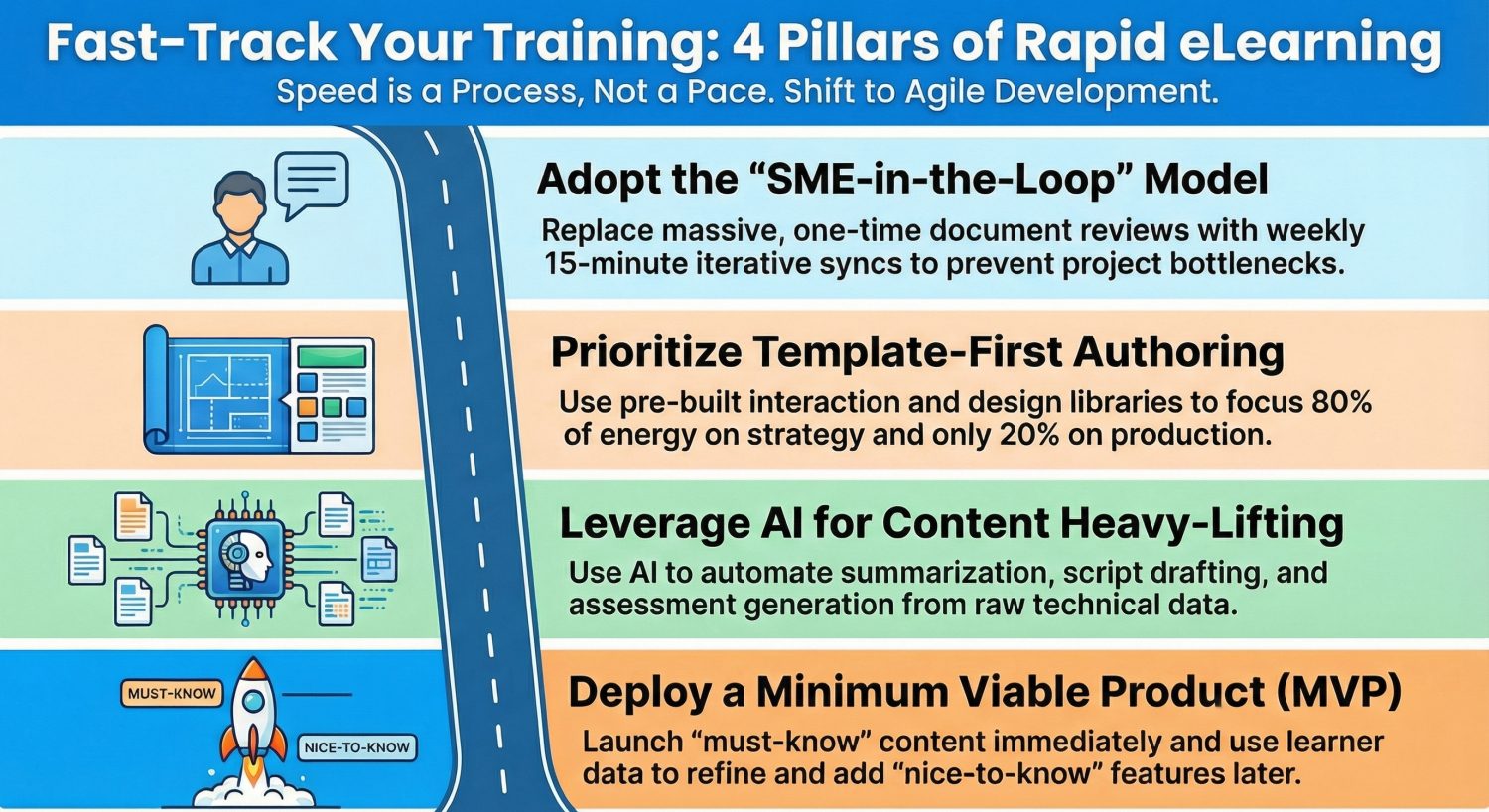
The most significant scheduling challenge in any training project often revolves around the availability of the Subject Matter Expert (SME). SMEs are inherently high-value individuals—they are the engineers, the lead sales reps, or the compliance officers. Because they are vital to operations, L&D projects often sit at the bottom of their priority list, making their time the most precious resource in the development cycle.
A core rapid eLearning development strategy is to move away from the “waterfall” method of content review. In the traditional workflow, the storyboard serves as the vital foundation of the project. However, delivering this essential blueprint as one massive, 50-slide document can create a logistical hurdle. Even the most dedicated SMEs often find it difficult to carve out the significant blocks of time required for such a monolithic review alongside their primary responsibilities.
Instead, use an iterative approach. Schedule 15-minute weekly “stand-up” syncs where the SME reviews small, bite-sized modules in real-time via a review link. This respects the SME’s time and allows for immediate course correction. When the SME sees the project coming to life in increments, their engagement increases, and the project remains top-of-mind without becoming a burden.
Starting from a blank canvas is the enemy of speed. To maintain high authority and visual consistency across your corporate library, you must standardise your development environment.
Building a robust library of templates is one of the most effective rapid eLearning development strategies for scaling. This isn’t just about “look and feel”; it’s about functional architecture.
Build a library that includes:
By utilising these templates, you your instructional designers can focus 80% of their energy on high-level content strategy and only 20% on production, effectively flipping the traditional time-sink on its head.
AI is no longer just a supporting tool, it has become a core driver of speed and efficiency in rapid eLearning development. Today’s rapid development workflows must leverage Artificial Intelligence to bridge the massive gap between raw technical data and polished instructional content.
How to integrate AI into your rapid eLearning development strategies:
However, the “Human-in-the-Loop” remains essential. AI can hallucinate or miss the specific cultural nuances of your brand. Use AI to do the “heavy lifting” of the first draft, allowing your IDs to act as expert editors.
Rapid development doesn’t always mean “new” development. In many cases, the content already exists—it’s just trapped in an unusable format. One of the most efficient rapid eLearning development strategies is the conversion of legacy Instructor-Led Training (ILT) materials, recorded webinars, or static PDFs into interactive modules.
The “Chunking” Workflow: Don’t simply “dump” a PowerPoint into an authoring tool. That creates “shelfware” that learners ignore. Instead:
This transforms passive, forgotten content into an active, trackable learning experience in a fraction of the time it takes to build from scratch.
Perfectionism is the primary hurdle to rapid deployment. In many high-stakes industries, having a “good enough” module deployed today is infinitely better than a “perfect” module deployed in three months.
Focusing on the “Must-Know” versus the “Nice-to-Know” is a hallmark of sophisticated rapid eLearning development strategies.
The MVP Roadmap:
This agile philosophy ensures that the business receives value immediately while the L&D team continues to refine the experience.
Not all authoring tools are created equal for speed. While complex, “layers-based” tools offer deep customization, they often have steep learning curves that slow down the team and make it difficult for new hires to contribute.
When evaluating tools for your rapid eLearning development strategies, prioritize:
Selecting a tool like Rise 360 for standard content and Storyline 360 for complex simulations allows you to choose the “right tool for the right speed.”
Nothing kills a “rapid” timeline like a bug found post-launch. A chaotic QA process leads to endless “back-and-forth” emails and version control nightmares. To ensure your development remains fast, you must formalize the finish line.
The Essential Rapid QA Checklist:
By formalising this step into a non-negotiable, 30-minute check, you ensure that “fast” never translates to “flawed” in the eyes of the stakeholders.
Overcoming the challenges of modern training requires more than just faster typing or more developers; it requires a fundamental shift in the instructional design workflow. By integrating these rapid eLearning development strategies, organizations can transform from slow-moving information repositories into agile, performance-driven learning cultures.
The ultimate goal of rapid eLearning is simple: To get the right knowledge to the right people at the precise moment of need. In a world where the only constant is change, speed is no longer a luxury, it is the baseline for success.
Implementing shouldn’t feel like a solo mission. At Learning Owl, we specialize in helping organisations bridge the gap between complex training needs and high-speed delivery. Whether you need to convert legacy ILT, scale your content production, or implement AI-driven workflows, our experts are here to guide your transition to agile L&D.
Contact Learning Owl Today to discover how we can help you build high-impact training at the speed of business.
Thursday, 15Oct 2026
Engaging Technical Training Starts with a Simple…

Monday, 12Oct 2026
Ask most L&D leaders how they handle…

Thursday, 8Oct 2026
The National Education Policy 2020 has been…
Thursday, 15Oct 2026
Engaging Technical Training Starts with a Simple…
Monday, 12Oct 2026
Ask most L&D leaders how they handle…
Thursday, 8Oct 2026
The National Education Policy 2020 has been…
Thursday, 15Oct 2026
Engaging Technical Training Starts with a Simple Shift Engaging technical training begins when employees stop seeing training as information they have to complete and start seeing it as knowledge they…
Read More line_end_arrow_notch
Monday, 12Oct 2026
Ask most L&D leaders how they handle a growing training backlog, and the answer is usually the same: work harder, hire more, or stretch deadlines. Rarely does anyone ask the…
Read More line_end_arrow_notch
Thursday, 8Oct 2026
The National Education Policy 2020 has been analysed extensively. Education researchers have written about its vision. Policy commentators have assessed its ambition. State governments have published implementation roadmaps. EdTech platforms…
Read More line_end_arrow_notch