
Thursday, 26Feb 2026
Digital Training for Insurance Advisors: Reducing Mis-Selling Risks and Building Customer Trust
What happens when an insurance policy is…
Monday, 23Feb 2026
K-12 eLearning review cycles are one of the most underestimated operational risks in curriculum digitisation. While publishers focus on animation quality, platform integration and content coverage, excessive revision loops quietly consume time, inflate budgets and delay academic launches.
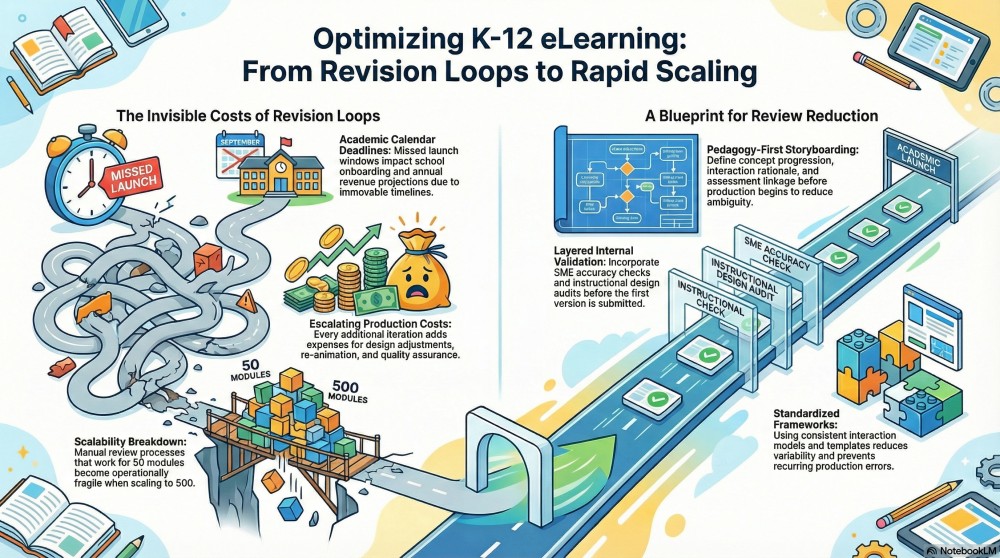
Unlike corporate training, K-12 eLearning operates within immovable academic timelines. When review cycles extend beyond planned buffers, the impact is not just operational—it is commercial. Missed release windows can affect school onboarding, sales commitments and annual revenue projections.
Understanding how K-12 eLearning review cycles arise and how to structurally reduce them is essential for publishers aiming to scale digital curriculum delivery.
K-12 eLearning review cycles are inherently more rigorous than revisions in other domains because academic accuracy is non-negotiable. Each module must align with:
A minor conceptual inconsistency can disrupt the learning journey. For example, a poorly structured explanation in Grade 4 Mathematics can affect comprehension of later concepts. Therefore, academic teams review digital modules with heightened scrutiny.
When production teams are not aligned with pedagogical frameworks from the outset, review cycles increase significantly.
While review loops may appear as minor delays, their cumulative impact is substantial.
K-12 publishing operates on fixed academic schedules. If digital modules are not finalised before the new school year, distribution opportunities narrow. Extended review cycles compress launch timelines and reduce flexibility.
Each review iteration requires additional design adjustments, re-animation, voice corrections and quality assurance checks. Across hundreds of modules, repeated K-12 eLearning review cycles can significantly inflate project costs.
Content directors and academic reviewers should be focusing on curriculum enhancement and strategic planning. However, repeated corrections, especially for foundational errors—divert attention to operational firefighting.
When early drafts consistently require major revisions, trust in the production workflow weakens. This often results in tighter scrutiny, longer approval cycles and further delays.
Review cycles that are manageable at a small scale become unsustainable when digitising entire grade-level curricula. If each module requires multiple iterations, scaling from 50 lessons to 500 becomes operationally fragile.
Reducing review friction requires identifying its structural origins.
If storyboards lack clarity in concept sequencing, misconception handling and assessment alignment, production teams interpret content inconsistently. This misalignment surfaces during academic review, triggering additional cycles.
K-12 eLearning review cycles often increase when modules reach publishers without prior SME validation. Academic accuracy should be confirmed internally before client review.
When visual elements are prioritised over instructional clarity, reviewers request structural changes rather than cosmetic edits. This shifts revisions from minor adjustments to major redesigns.
Without documented checklists and validation protocols, similar errors may recur across multiple modules, compounding review loops.
Reducing review cycles is not about accelerating corrections. It requires strengthening upstream alignment.
Storyboards should include:
A robust storyboard significantly reduces ambiguity during production.
An effective K-12 eLearning workflow should incorporate:
By ensuring Version 1 meets high academic standards, the number of external review cycles decreases naturally.
Consistency reduces variability. When interaction models and layout structures are standardised, production errors decrease and review predictability improves.
Planning review buffers backwards from launch deadlines ensures adequate time for revisions without jeopardising rollout schedules.
Publishers should monitor:
Data-driven insights allow structural improvements in future projects.
Effective management of K-12 eLearning review cycles directly influences:
Reducing review friction improves not only operational efficiency but also stakeholder confidence. When academic teams observe consistent alignment between curriculum intent and digital execution, collaboration becomes proactive rather than corrective.
Successful K-12 curriculum digitisation requires an execution model that integrates pedagogy, production and quality assurance from the beginning. When review cycles are treated as measurable performance indicators rather than unavoidable delays, continuous improvement becomes possible.
Publishers who institutionalise structured review reduction strategies gain a competitive advantage in digital education markets. They can scale faster, respond to policy updates efficiently and launch confidently within academic deadlines.
K-12 eLearning review cycles are not minor workflow inconveniences. They are measurable indicators of alignment between academic vision and digital execution. When left unmanaged, they increase costs, delay launches and weaken scalability.
However, with structured storyboarding, layered validation and calendar-driven production planning, publishers can significantly reduce revision loops and strengthen operational certainty.
At Learning Owl, we operate with a pedagogy-first production framework designed specifically to minimise K-12 eLearning review cycles. With extensive experience in large-scale curriculum digitisation, layered quality assurance protocols and embedded SME validation, Learning Owl helps publishers:
If your organisation is navigating complex curriculum transformation, strengthening your review architecture may be the first step towards execution certainty.
Partner with Learning Owl and build digital curriculum systems that scale without friction.
Thursday, 26Feb 2026
What happens when an insurance policy is…
Monday, 23Feb 2026
K-12 eLearning Review Cycles Are Quietly Undermining…

Thursday, 19Feb 2026
Custom eLearning solution is becoming one of…
Thursday, 26Feb 2026
What happens when an insurance policy is…
Monday, 23Feb 2026
K-12 eLearning Review Cycles Are Quietly Undermining…
Thursday, 19Feb 2026
Custom eLearning solution is becoming one of…
Thursday, 26Feb 2026
What happens when an insurance policy is sold incorrectly? The customer loses trust, complaints rise, regulators intervene, and the company’s reputation suffers. Digital training for insurance advisors is becoming essential…
Read More line_end_arrow_notch
Monday, 23Feb 2026
K-12 eLearning Review Cycles Are Quietly Undermining Digital Curriculum Projects K-12 eLearning review cycles are one of the most underestimated operational risks in curriculum digitisation. While publishers focus on animation…
Read More line_end_arrow_notch
Thursday, 19Feb 2026
Custom eLearning solution is becoming one of the most effective ways to build financial awareness and literacy across diverse audiences today. From students and young professionals to employees and community…
Read More line_end_arrow_notch