
Thursday, 26Feb 2026
Digital Training for Insurance Advisors: Reducing Mis-Selling Risks and Building Customer Trust
What happens when an insurance policy is…
Thursday, 26Feb 2026
What happens when an insurance policy is sold incorrectly? The customer loses trust, complaints rise, regulators intervene, and the company’s reputation suffers.
Digital training for insurance advisors is becoming essential as insurers seek to reduce mis-selling risks while improving advisor performance and customer satisfaction. In an increasingly regulated and competitive market, advisors must not only sell policies but also ensure customers fully understand products and receive solutions suited to their needs.
However, traditional training methods often fail to prepare advisors for complex, real-world sales conversations. As a result, mis-selling incidents continue to affect insurers worldwide.
So, how can organisations reduce these risks while still driving performance? The answer lies in smarter, technology-driven training approaches.
Mis-selling rarely happens intentionally. In most cases, it stems from gaps in product knowledge, pressure to meet targets, or misunderstanding customer requirements.
Common causes include:
Consequently, customers feel misled when claims are rejected or coverage does not match expectations. Complaints, regulatory scrutiny, and customer churn follow.
Therefore, insurers must focus on preventive training rather than corrective action.
Insurance training has long relied on classroom sessions, manuals, and occasional workshops. While useful, these methods struggle to keep pace with evolving products and regulations.
Several limitations exist.
Advisors often receive large volumes of technical information in short sessions, leading to poor retention.
Training may explain products but rarely prepares advisors for actual customer interactions.
Many organisations conduct onboarding training but fail to reinforce learning continuously.
Classroom-based programs differ across regions, resulting in inconsistent advisor capabilities.
As a result, advisors may understand policies theoretically but struggle to apply knowledge during sales conversations.
Digital training platforms enable organisations to provide consistent, scalable, and practical learning experiences to advisors across locations.
More importantly, they focus on application rather than memorisation.
Advisors practise customer interactions in simulated environments, learning how to recommend appropriate products while addressing customer concerns.
Training modules highlight regulatory requirements and ethical sales practices, reducing compliance risks.
Advisors can revisit modules anytime, reinforcing product understanding and sales techniques.
Short learning modules allow advisors to quickly learn new policy changes or product features.
Managers gain insights into advisor progress, knowledge gaps, and training effectiveness.
Consequently, advisors become more confident and accurate in policy recommendations.
Implementing digital training programs brings measurable business benefits.
Advisors understand regulatory expectations better, reducing penalties and complaints.
Customers receive clearer explanations, resulting in higher satisfaction and loyalty.
Well-trained advisors handle customer queries effectively and recommend appropriate solutions.
New hires become productive faster through structured digital training pathways.
Digital delivery ensures uniform learning experiences across branches and distribution networks.
Ultimately, training shifts from a routine requirement to a strategic advantage.
However, successful implementation requires thoughtful design rather than simply digitising manuals.
Training should reflect actual conversations advisors encounter daily.
Visual aids, animations, and examples make policy features easier to understand.
Advisors should practise responding to customer concerns realistically.
Learning improves when advisors understand why certain approaches succeed or fail.
Ongoing refresher modules help maintain knowledge and compliance awareness.
When training mirrors real advisory situations, behavioural change becomes more likely.
Insurance customers today expect transparency, clarity, and personalised solutions. Advisors must therefore evolve from product sellers into trusted consultants.
Digital training for insurance advisors supports this transition by equipping advisors with skills in customer understanding, ethical selling, and regulatory compliance.
Furthermore, emerging technologies such as AI-driven learning analytics and adaptive learning pathways are making training even more personalised and effective.
Companies that invest in modern training approaches position themselves for long-term growth and stronger customer relationships.
Imagine buying insurance and discovering later that your policy doesn’t cover what you thought it did. Trust breaks instantly. However, when advisors understand products deeply and match them to customer needs correctly, relationships strengthen.
Digital training empowers advisors to guide customers responsibly rather than simply close sales. It reduces mis-selling risks while improving both advisor performance and customer satisfaction.
And when trust grows, business naturally follows.
If your organisation wants to reduce mis-selling risks while building a confident, customer-focused advisory force, it’s time to modernise training.
👉 Connect with Learning Owl to design impactful digital training programs that help insurance advisors deliver compliant, transparent, and customer-centric solutions.
Thursday, 26Feb 2026
What happens when an insurance policy is…
Monday, 23Feb 2026
K-12 eLearning Review Cycles Are Quietly Undermining…

Thursday, 19Feb 2026
Custom eLearning solution is becoming one of…
Thursday, 26Feb 2026
What happens when an insurance policy is…
Monday, 23Feb 2026
K-12 eLearning Review Cycles Are Quietly Undermining…
Thursday, 19Feb 2026
Custom eLearning solution is becoming one of…
Thursday, 26Feb 2026
What happens when an insurance policy is sold incorrectly? The customer loses trust, complaints rise, regulators intervene, and the company’s reputation suffers. Digital training for insurance advisors is becoming essential…
Read More line_end_arrow_notch
Monday, 23Feb 2026
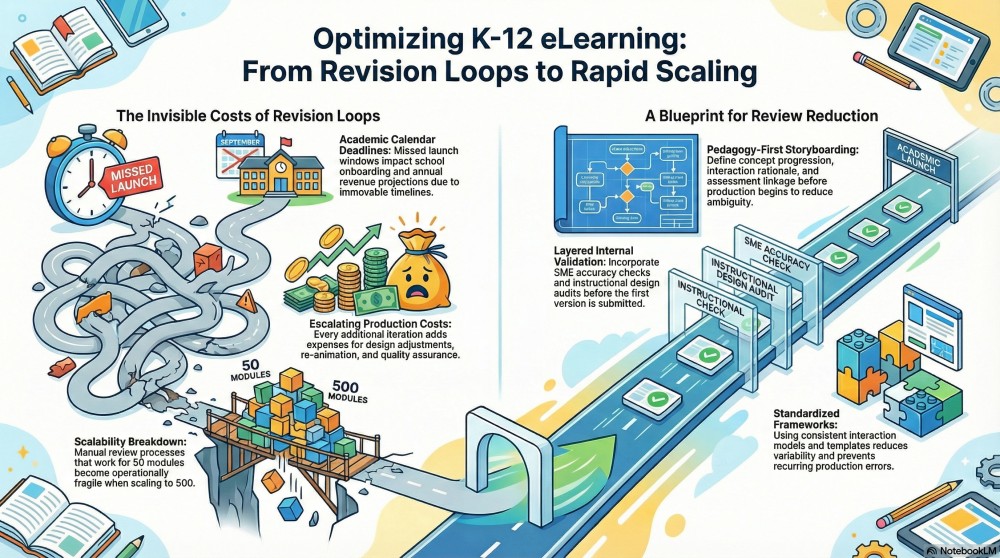
K-12 eLearning Review Cycles Are Quietly Undermining Digital Curriculum Projects K-12 eLearning review cycles are one of the most underestimated operational risks in curriculum digitisation. While publishers focus on animation…
Read More line_end_arrow_notch
Thursday, 19Feb 2026
Custom eLearning solution is becoming one of the most effective ways to build financial awareness and literacy across diverse audiences today. From students and young professionals to employees and community…
Read More line_end_arrow_notch