
Thursday, 29Oct 2026
Cybersecurity Awareness Training That Employees Remember: 9 Practical Tips
Firewalls, antivirus tools and access controls are…
Monday, 9Mar 2026
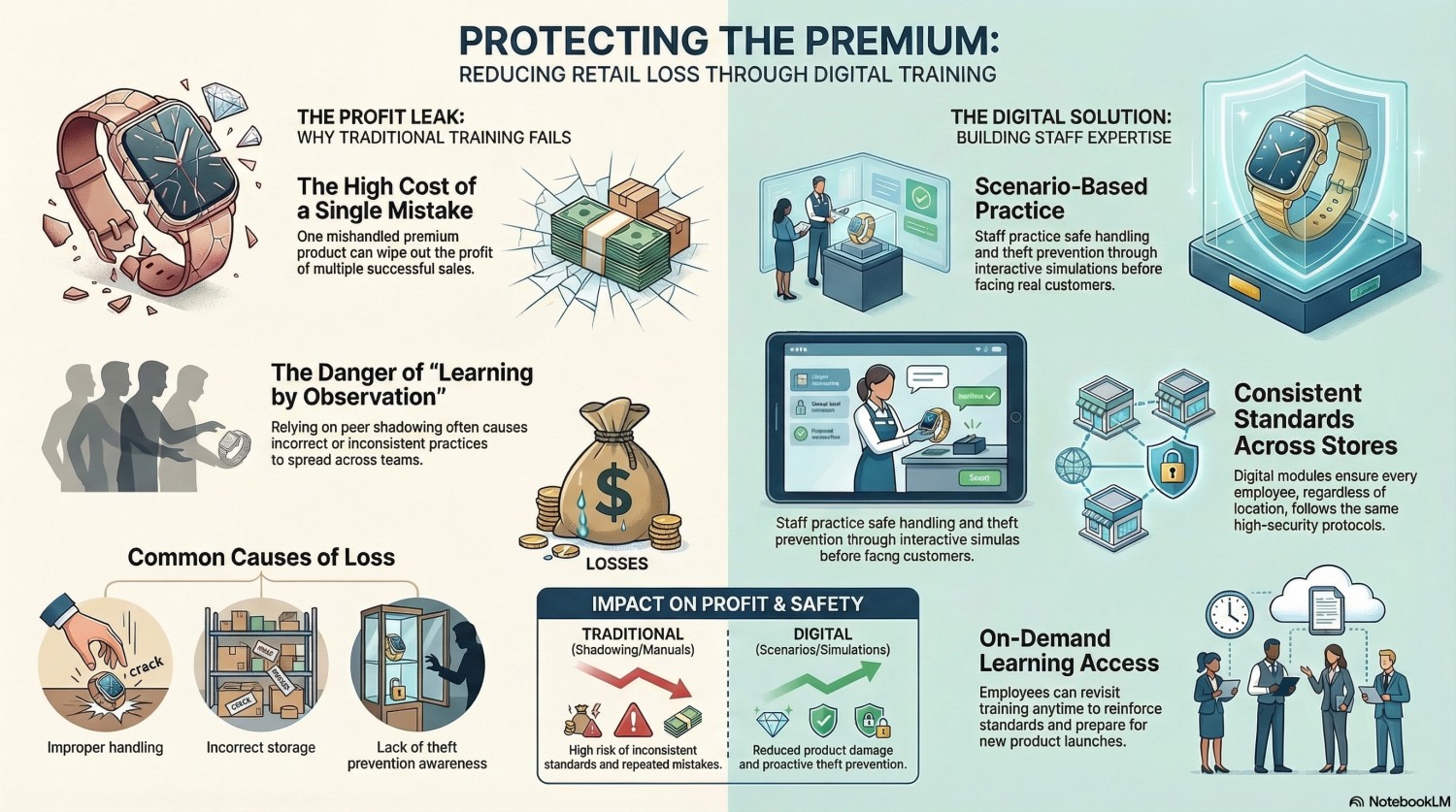
Training retail staff to handle high-value products without losses has become essential as retailers increasingly deal with premium electronics, luxury goods, jewellery, and high-end appliances. While these products generate strong revenue, they also carry higher risks—damage, theft, mishandling, or incorrect customer handling can lead to serious financial losses.
Therefore, retailers must ensure that frontline staff understand how to manage, secure, and sell high-value products responsibly. However, many organisations still rely on basic training methods that fail to prepare employees for real store situations.
Let’s explore why losses occur and how modern digital training solutions help retailers protect profits while enhancing customer experience.
Retail losses related to premium products rarely result from deliberate negligence. Instead, they often stem from insufficient training or unclear processes.
Common challenges include:
Moreover, new staff members often learn by observing peers, which may lead to inconsistent or incorrect practices spreading across teams.
Consequently, losses accumulate quietly, impacting store profitability.
Many retail organisations still rely on shadow training, manuals, or brief induction sessions.
However, traditional training approaches create several issues.
New employees often learn by watching colleagues, but incorrect practices may get repeated.
Training conducted only during onboarding does not reinforce learning over time.
Different stores train staff differently, leading to varied standards.
Employees rarely practise handling high-value items before facing real customer situations.
As a result, staff remain underprepared when dealing with expensive merchandise.
Modern retailers are adopting digital learning solutions that provide consistent, practical, and scalable training experiences.
More importantly, digital training focuses on application rather than theory.
Staff practise safe handling of premium items through interactive scenarios before interacting with real customers.
Employees learn how to identify suspicious behaviour and follow proper escalation processes.
Digital simulations help staff practise demonstrating products safely while engaging customers confidently.
Employees learn store protocols for stock movement, storage, and documentation.
Staff can revisit training modules whenever required, ensuring continuous reinforcement.
As a result, staff confidence improves while store losses reduce.
Retailers implementing structured digital training programs often see measurable improvements.
Employees handle premium items carefully, reducing accidental damage.
Staff become more alert and proactive in preventing shrinkage.
Customers feel more comfortable purchasing expensive products when staff demonstrate expertise.
New employees become competent more quickly.
Training delivery remains uniform across locations.
Ultimately, improved training directly protects profit margins.
However, simply digitising manuals is not enough. Training must be practical and engaging.
Scenarios should replicate daily store challenges.
Videos and simulations should show proper handling methods.
Employees should practise engaging customers without risking product safety.
Learning improves when staff understand consequences of mistakes.
Short refresher modules maintain awareness and standards.
Practical learning creates behavioural change that directly reduces losses.
Retail is evolving rapidly as customers demand premium experiences alongside product safety. Employees must balance sales, service, and security responsibilities simultaneously.
Digital learning platforms now enable retailers to provide training anytime, anywhere, ensuring staff stay updated with new product launches, handling procedures, and store protocols.
Furthermore, technologies like mobile learning and performance analytics help managers identify training gaps and provide targeted learning support.
Retailers investing in continuous learning create safer store environments while improving customer satisfaction.
Think of high-value products as fragile profit generators. Mishandling them not only causes financial loss but also damages customer trust.
However, when retail staff receive practical training, they confidently handle premium merchandise while delivering excellent customer service. Loss prevention becomes part of daily behaviour rather than a forced rule.
In other words, the right training transforms employees from product handlers into trusted product experts.
And when expertise grows, losses naturally decline.
If your organisation wants to reduce product losses while improving staff confidence and customer experience, modern digital learning solutions can make the difference.
👉 Connect with Learning Owl to build impactful retail training programs that help store teams handle high-value products confidently and responsibly.
Thursday, 29Oct 2026
Firewalls, antivirus tools and access controls are…
Monday, 26Oct 2026
It is the last week of the…

Thursday, 22Oct 2026
A new core banking platform, an ERP…
Thursday, 29Oct 2026
Firewalls, antivirus tools and access controls are…
Monday, 26Oct 2026
It is the last week of the…
Thursday, 22Oct 2026
A new core banking platform, an ERP…
Thursday, 29Oct 2026
Firewalls, antivirus tools and access controls are essential, but they all share one weak spot: people. A rushed click on a convincing email, a reused password, or a file shared…
Read More line_end_arrow_notch
Monday, 26Oct 2026
It is the last week of the quarter, and a regional sales head at a mid-sized NBFC is looking at a dashboard that says 97 percent of her collections team…
Read More line_end_arrow_notch
Thursday, 22Oct 2026
A new core banking platform, an ERP upgrade, a fresh CRM for the sales team or a new claims system for an insurer: every organisation goes through system changes, and…
Read More line_end_arrow_notch